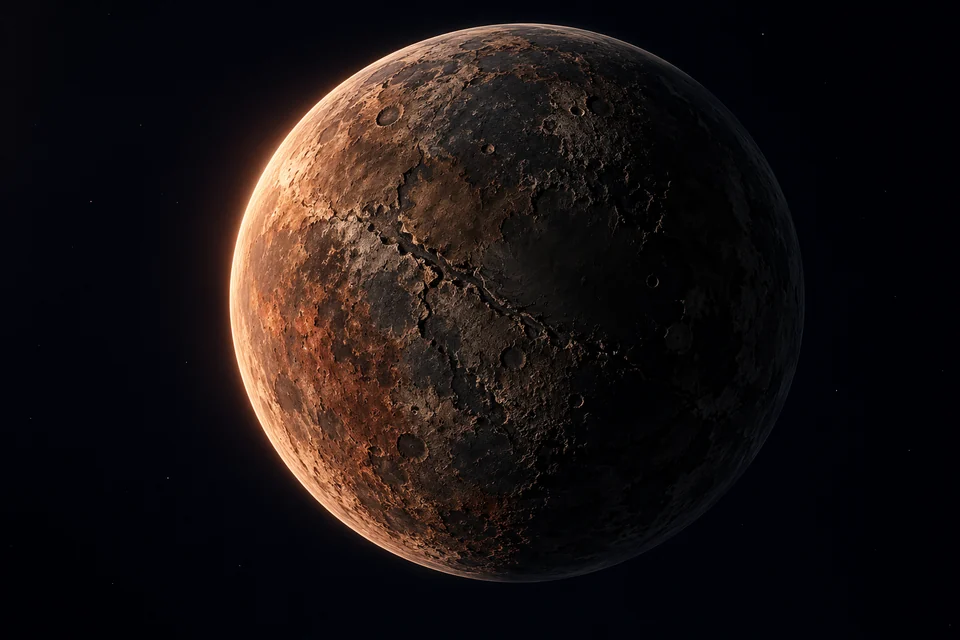
Kepler-444 e
Kepler-444 e orbits the star Kepler-444, 118.8 light-years from Earth. It completes an orbit in 7.743 Earth days.
Get to know this world ↓Size-based classification; composition may be uncertain.
Around 45% smaller in radius than Earth.
Time to complete one orbit.
Its light travels for roughly 119 years to reach us.
Transit
Overview
Kepler-444 e is one of the confirmed worlds in the NASA Exoplanet Archive. Recorded as discovered in 2015. The credited discovery facility is Kepler. Its Transit evidence gives us a way to study a planet that is usually too faint to see directly.
Its recorded radius is 0.55 times Earth's radius. Size is useful for comparison, but it cannot establish surface conditions by itself.
The planet
The archive lists a mass or minimum-mass value of 0.1 Earth masses (Mass). Radius: 0.55 Earth radii.
Mass and radius constrain possible interiors; multiple compositions can fit a given set of measurements.
Orbit & year
A year here lasts 7.743 Earth days. Its recorded semi-major axis is 0.07 AU. One AU is roughly the Earth–Sun distance.
Eccentricity: 0.1. Zero describes a circular orbit; increasing values describe more elongated ellipses.
Host star
Planetary system
5 confirmed planets are stored for this star.
Kepler-444 b · 3.6-day orbit
Kepler-444 c · 4.546-day orbit
Kepler-444 d · 6.189-day orbit
Kepler-444 e · 7.743-day orbit
Kepler-444 f · 9.74-day orbit
Discovery
Reported discovery year: 2015. Method: Transit. Facility: Kepler.
First stored in this atlas: 04/10/2026. This is an ingestion date, not a confirmation date.
How these methods work ↗Potential habitability
The data here does not establish habitability, liquid water, or life. An appropriate atmosphere and many other conditions would be needed.
The listed equilibrium temperature is 727 K. This is an estimated energy-balance temperature, not a measured surface temperature.
Understand the habitable zone ↗What do we actually know?
The underlying light, motion or timing signal. Usually not a photograph of the planet.
Parameters derived from observations, with instrument and model uncertainty.
Our light-year conversion and browsing class are calculated from archive values.
Equilibrium temperature is an energy-balance estimate, not surface weather.
Possible composition depends on models and may not be unique.
Surface conditions and the presence of life are not established here.
Measured signals are interpreted through models. The archive’s composite table combines published values and may include calculated estimates. Values do not necessarily form one self-consistent solution.
Radius and mass can be estimated or inferred, orbital period comes from recurring observations, and size classification is calculated by this site. Atmospheric and surface conditions remain unknown unless established by specific observations.
Consult the archive for individual parameter references and uncertainty intervals before scientific use.
Scientific data
| Radius | 0.546 Earth radii |
|---|---|
| Mass / minimum mass | 0.1 Earth masses (Mass) |
| Orbital period | 7.74349 Earth days |
| Semi-major axis | 0.0696 AU |
| Eccentricity | 0.1 |
| Equilibrium temperature | 727 K · estimated, not surface temperature |
| Host star temperature | 5,046 K |
| Host star mass | 0.758 Solar masses |
| Host star radius | 0.752 Solar radii |
| Distance | 36.4396 parsecs |
| Discovery year | 2,015 |
| Discovery method | Transit |
| Discovery facility | Kepler |
| Discovery publication | 2015-02 |
| Stellar spectral type | K |
Uncertainties and parameter provenance
Archive uncertainty ranges and published references, where available. A missing uncertainty does not imply an exact value.
| Parameter | Uncertainty / source |
|---|---|
| Radius | +0.017 / -0.015Campante et al. 2015 |
| Mass / minimum mass | +0.2 / -0.1Hadden & Lithwick 2017 |
| Orbital period | +0.00002 / -0.00002Campante et al. 2015 |
| Equilibrium temperature | Upper uncertainty unavailable / Lower uncertainty unavailableQ1-Q17 DR25 KOI Table |
Sources
NASA Exoplanet Archive · Planetary Systems Composite Parameters (PSCompPars).
Open the scientific archive record ↗Last changed in this atlas: 04/10/2026, 11:39:41. Read our methodology.